
How to Make Almond Milk ~ this one’s a total game changer. Fresh, creamy, and so easy you’ll never go back to store-bought.

Don't Lose This Recipe!
I finally tried almond milk ~ and wow. I had no idea it would be this creamy or have such a mellow, nutty flavor. Honestly, I think I might like it more than dairy milk (and I’ve been a milk drinker forever).
Turns out almond milk has been around since the Middle Ages, and it’s easy to see why. It’s low in calories and fat, naturally dairy-free, and packed with nutrients. It’s also gentler on the planet and skips the whole hormone-and-saturated-fat thing.
Bottom line? I’m sold.
And guess what? It’s one of the easiest DIY projects out there, and I’m telling you, once you try it with your morning muesli or granola, you’ll never eat it any other way. (And if you get interested in the whole idea of making your own versions of commercial foods, definitely check out my 10 Ultra-Processed Foods I’d Rather Make at Home!)

If you buy raw almonds in bulk you can whip this up on a weekly basis. It takes just minutes and the result is eye opening. If you’re on the fence, you have to try it.

how to make almond milk
The method is simple —
- it starts with almonds that have been soaked in water overnight. This apparently makes all their nutrients more easily digestible, but you can skip this step if you are in a hurry.
- You grind the almonds in a blender until they are completely pulverized. It doesn’t take long.
- Then blend in a quart of water.
- The resulting milky liquid is strained through cheesecloth, a fine mesh strainer, or a clean dishcloth. If you get really into this, buy yourself a Nut Milk Bag, especially made for draining the nut mixture. Give it a good strong squeeze to get out all the milky liquid, and you’re in business.
- Refrigerate until icy cold and then use just like dairy milk. It truly is quick and easy, and it’s truly delicious, I would not lie to you.

Some people like to add a little sweetener like honey, and/or a touch of vanilla. I prefer mine plain.

 Add The View from Great Island as a Trusted Google Source

Homemade Almond Milk
Equipment
- blender
- nut milk bag for straining
Ingredients
- 1 cup raw almonds, heaped
- 4 cups water
Instructions
- Cover the almonds with water and soak overnight. This helps in digestion and absorption of their nutrients.
- Drain the almonds and add them to your blender or food processor. Blend until the almonds are finely pulverized, stopping to scrape down the sides of the blender if necessary.
- Once the almonds are finely processed, add 4 cups of cold water and process until well combined.
- Drain the milk through a nut milk bag, jelly bag, or several layers of cheesecloth lining a fine mesh strainer. Be sure to squeeze every last drop of the wonderful nut milk out.
- Pour the almond milk into a clean container and store, covered, in the fridge. It will keep for a week. And be sure to give it a shake or a stir before drinking.
Nutrition
Commercial almond milk taste test
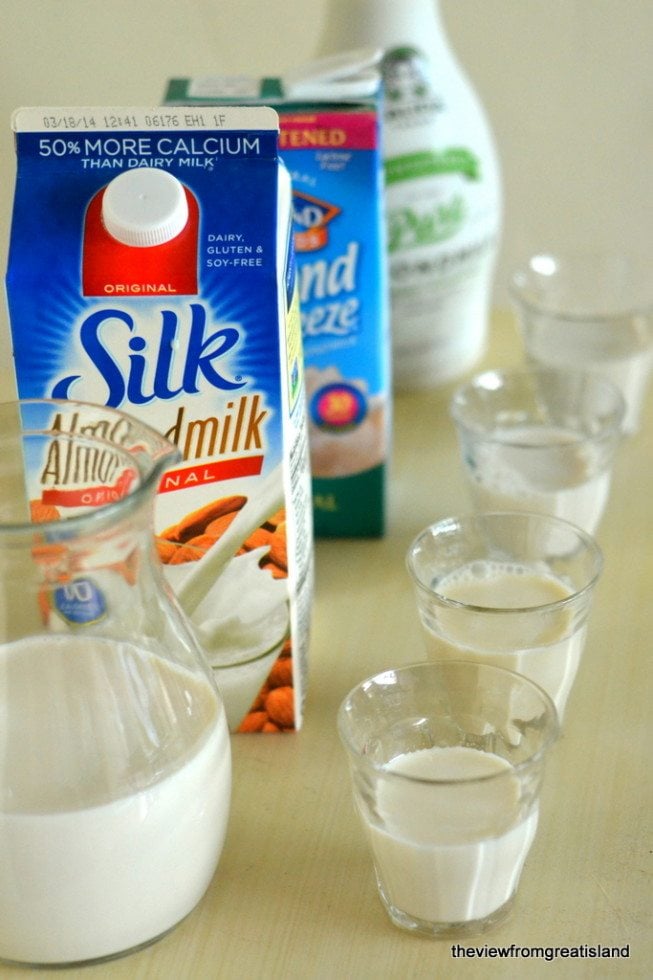
I tested my homemade version against 3 of the top almond milk brands: Silk, Almond Breeze, And Califia Farms. You can buy almond milk with flavoring and sweeteners added, but I bought the plain versions of each. I’m glad to report that all four were pleasant, and worth trying. I’ll lay out the subtle differences for you here and hopefully it will help you make a choice depending on your preferences.
Overall Best: My Homemade won, no surprise. It was light and fresh, with a very subtle but true raw almond flavor.
Best for kids: The Silk won here…it was definitely a little thicker and a little sweeter than the others. If you’re afraid of almond milk, start here. This one would be great in sweet recipes like cocoa, puddings, etc, and also perfect on kid’s cereal.
Most Neutral: Almond Breeze was the most neutral, and therefore I would say the most like regular milk. It had the least pronounced flavor or aroma of the four.
Color: All four were more or less the same slightly off white color. The Homemade was the whitest, Califia Farms was the darkest.
Viscosity: The Homemade was the lightest. Silk was the thickest, and was too artificially thick for my taste, at least for straight drinking purposes. Again it would be good for dessert applications like milkshakes, rice pudding, or something like that.
Separation: Upon sitting, the Homemade separated fairly quickly. The other three remained homogenized over the course of an hour. In any case you should shake or stir all almond milks before drinking.
Aroma: The Homemade has a distinct raw almond scent. Silk has a pleasant, slightly toasted aroma. Califia Farms has an off aroma that I can’t place and don’t care for. Almond Breeze had the least scent of all of them, again, making it closer to regular milk.
Almond Flavor: The Homemade had the freshest, most pleasant raw almond flavor. Almond Breeze was a close second. The Califia Farms had a slight aftertaste that I didn’t love. Almond Breeze was neutral.
This is just my own personal ranking, but they are close, so if you’re interested, I recommend giving them all a taste and judging for yourself.
#1 Homemade almond milk
#2 Almond Breeze
#3 Califia Farms
#4 Silk (only because of the sweetness, if you like things sweet, you’ll like this one)









Hi Sue!
I’ve had the almond Silk (I use it in smoothies) and if I’m remembering correctly, made almond milk years ago for a recipe. I don’t think I’ve ever tasted either plain. (not much of a milk drinker) Coconut milk I always use to replace milk in recipes, so much more flavor.
Can’t wait to give this a try!
I keep looking at almond milk. Somewhat scared of it but definitely intrigued, Your post has increased my interest….
I know exactly what you mean, I would look at it in the grocery store and it just put me off..it’s so funny how we get preconceived ideas about unfamiliar foods.
Awesome post. Going to make this soon. Ive been drinking almond milk for years, however, not too long ago realized that Blue Diamond brand contains a nasty ingredient called ” Carrageenan”… liquid plastic more or less. Its used as a thickener. Silk brand does NOT contain this though. Stick with Silk brand if not making your own.
Let’s face it, most mass produced food these days contains stuff we’d ideally not like to consume. I’m happy that this one is so easy to make at home!
I just bought a nut milk bag and I have been eager to try my hand at homemade nut milks. Do you have any suggestions as to where to purchase large quantities of raw nuts? Are there any brands or online retailers that you would suggest? I’ve just been going to my local organic market and using the bulk bins, but I was wondering if there was a less expensive option.
Great question, Marie, I think I’ll update the post with this info. There are lots of online nut suppliers, and I am guessing that they would have the freshest and best prices. Although in a pinch Trader Joe’s is always pretty reasonable. And don’t forget, that it only takes 1 cup of nuts for a quart of almond milk, so we’re not talking huge quantities here.
Here are a few online sources: Oh Nuts!
Just Almonds
Nuts.com
Amazing! You know, I always buy Silk, and now I must try Almond Breeze for sure!
ok, since you asked about what “could” be potentially bad about almond milk, the commercial ones for the most part are thickened with carrageenan.
Recently I read this article that brings some points to be taken in account, particularly if a person suffers from IBS and other digestive tract illnesses (not my case)
http://ohsheglows.com/2013/01/07/carrageenan-in-our-food/
I love it, and will continue enjoying it, I don’t drink a gallon of it per day, maybe 1/2 cup? Delicious on cereal, by the way..
I am not inclined to make it myself, I like the convenience of buying it ready, but of course, your taste test is making me re-consider my own views…
Great post!
Great info, Sally. I looked on the labels and they all are thickened with something or other. One more reason to make it homemade. I like the thinner texture better, anyway.
Could you add the soaking water rather than “fresh” water to the ground up almonds?
No, I don’t think so, Teresa, but I’ll look into it. I don’t think the almonds leach out any nutrients through the soaking, so there’s no need to re-use the water.
YAY for almond milk!! Please tell me you saved the pulp too. Nothing like getting a cup or two of almond meal thrown in for free. 🙂
Weeeeell, I didn’t save the pulp, I know I should have. Next batch, I promise. I’m thinking it might be good in oatmeal.
Liz I have to try your nut creams…the hazelnut cream sounds so good! It’s such fun to think outside the box 🙂
Oh, about soaking and the water. There are lots of different opinions but I do the following with both nuts and beans:
Rinse them very well
Soak for an hour, then rinse well and fresh water
Soak for 4-6 hours or overnight and blend or cook with that water.
I eat a lot of both nuts and beans and don’t have digestion issues and I use fresh organic raw nuts and heirloom beans. I think the soaking liquid adds a lot of flavor to both.
I need to change my method…did some reading. It is not just about digestion – there are bioavailability of nutrients affected by non-soaked nuts.
http://www.thenourishinggourmet.com/2008/07/soaking-nuts.html is the article I thought was very thorough and totally changed my mind about my method.
Thanks for the heads up, Sue!
We are Silk fans but I’ve never made homemade so I can’t say for certain! Beautiful photos and a terrific review – thanks Sue!
Thanks Tricia — I’m so happy to have discovered it, I’m going to try cooking and baking with it next.
Your almond milk is beautiful!
I am a huge fan of almond milk (homemade) as well as cashew milk (cream)…I don’t typically drink either but use them in things. I even made a very decadent hazelnut cream for a Christmas latte.
I have successfully used cashew cream anywhere heavy cream is called for – even whipped it in my co2 whipper thing.
I also enjoy cow and goat products but is great to have the variety and the different nutrition profile as you pointed out.
Bottomline – another vote for nut milks as an option!